






Precision agriculture is transforming Indian farming through data-driven decision making, with adoption rates increasing by 300% over the past two years. This technological revolution enables farmers to optimize inputs, maximize yields, and improve sustainability while reducing costs. From small-holder farms to large agricultural enterprises, precision farming technologies are proving their value across India’s diverse agricultural landscape.
The Data-Driven Agriculture Revolution
Traditional farming relies heavily on experience, intuition, and generalized practices applied uniformly across entire fields. Precision agriculture challenges this approach by recognizing variability within fields and optimizing management accordingly. Data becomes the foundation for every farming decision, from seed selection to harvest timing.
The precision agriculture market in India reached ₹15,000 crores in 2024, growing at 45% annually. This growth reflects increasing farmer awareness, technology affordability improvements, and demonstrated return on investment. Government support through subsidies and training programs accelerates adoption across different farmer segments.
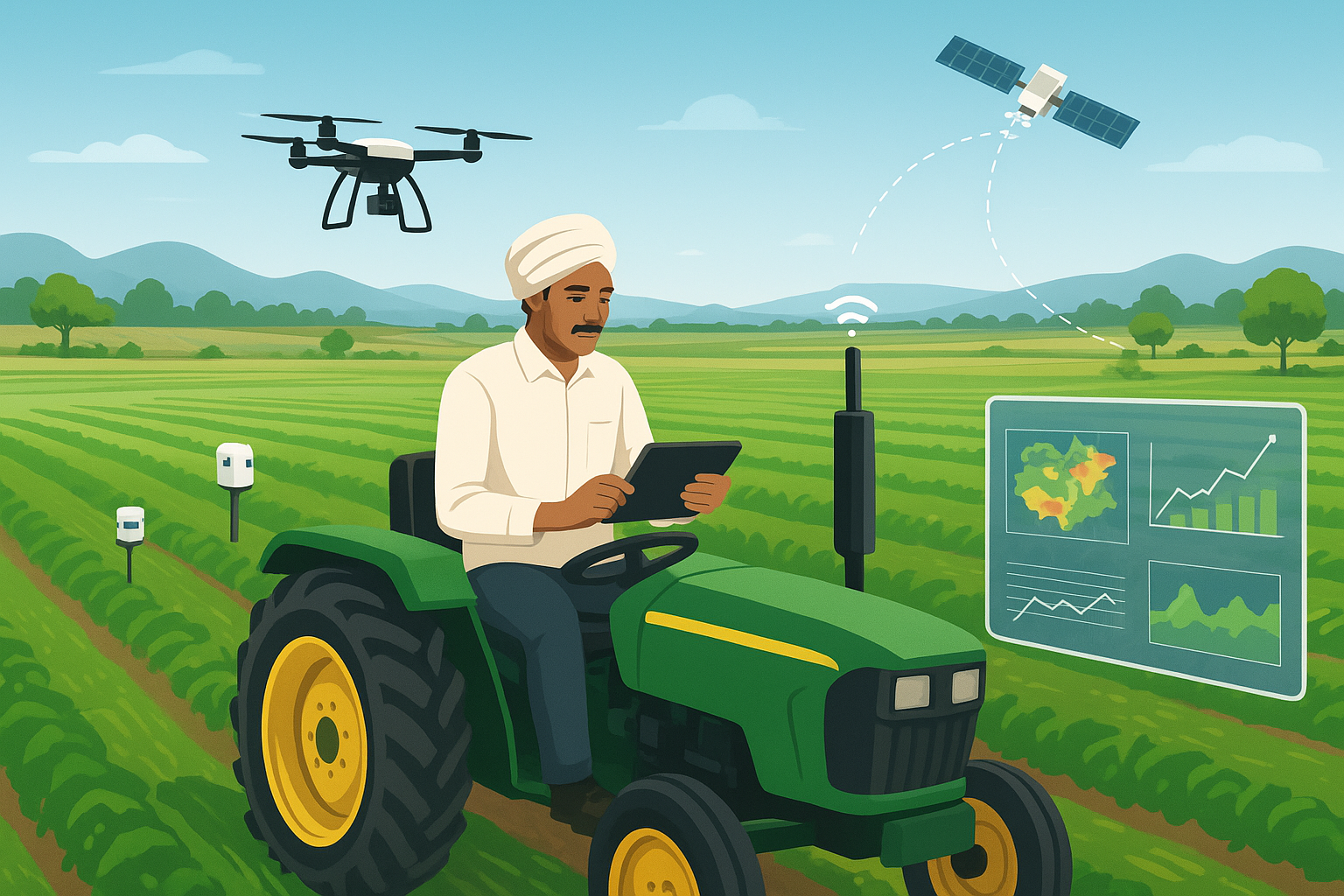
Technology integration spans multiple domains including GPS guidance, variable-rate application, remote sensing, soil sampling, yield mapping, and automated equipment control. These technologies work synergistically to create comprehensive farm management systems that optimize every aspect of agricultural production.
GPS and Navigation Technology Adoption
GPS technology forms the foundation of precision agriculture systems in India. Auto-steer systems guide tractors with centimeter-level accuracy, reducing overlap and improving efficiency. GPS-guided planters ensure precise seed placement and population control. Navigation systems optimize field operations and reduce fuel consumption.
Adoption rates vary significantly across regions and farm sizes. Punjab and Haryana lead adoption with 60% of large farms using GPS-guided equipment. Maharashtra follows with 45% adoption in sugarcane cultivation. Karnataka shows 40% adoption in horticulture operations.

Cost reductions drive adoption decisions. GPS guidance reduces fuel consumption by 15-20% through optimized field patterns. Overlap reduction saves 10-15% on seed, fertilizer, and chemical costs. Labor efficiency improves by 25-30% through automated guidance systems.
Indian manufacturers are developing cost-effective GPS solutions. Mahindra’s auto-steer systems cost 60% less than imported alternatives. Tafe’s precision guidance reduces operational complexity while maintaining accuracy. Local manufacturing makes technology accessible to medium-scale farmers.
Variable-Rate Technology Implementation
Variable-rate application technology represents the most visible precision agriculture application. Soil variability mapping guides fertilizer application rates across different field zones. Prescription maps specify exact application rates for each location. Equipment automatically adjusts rates based on GPS position.
Soil sampling density determines mapping accuracy. Grid sampling every 1-2 hectares provides adequate detail for most crops. Intensive sampling every 0.5 hectares benefits high-value crops. Zone sampling based on soil types reduces sampling costs while maintaining effectiveness.
Fertilizer savings are substantial across different crops. Rice cultivation saves 20-25% on nitrogen fertilizer through variable-rate application. Wheat production reduces phosphorus usage by 15-20%. Cotton cultivation optimizes potassium application with 25-30% savings.
Equipment availability is expanding rapidly. Variable-rate spreaders are now available from multiple Indian manufacturers. Precision planters integrate seeding rate control. Spray systems provide variable-rate pesticide application. Custom service providers offer equipment access for smaller farms.
Remote Sensing and Satellite Technology
Satellite imagery and remote sensing provide comprehensive field monitoring capabilities. Multispectral images reveal crop health variations invisible to human observation. Normalized Difference Vegetation Index (NDVI) maps show plant vigor patterns. Early detection of stress enables timely interventions.
Resolution improvements make satellite data more actionable. Current satellites provide 3-5 meter resolution suitable for field-level analysis. Upcoming satellite constellations will offer 1-meter resolution enabling within-field management zones. Real-time processing provides timely information for decision making.
Indian Space Research Organisation (ISRO) satellites support domestic precision agriculture. ResourceSat and CartoSat provide agricultural monitoring data. RISAT satellites offer weather-independent monitoring. Data access costs are subsidized for agricultural applications.
Commercial satellite services complement government programs. Planet Labs provides daily imagery for crop monitoring. Maxar offers high-resolution images for detailed analysis. Indian companies like SatSure provide agricultural analytics services.
Soil Health Management Revolution
Precision soil management transforms nutrient application from blanket recommendations to site-specific prescriptions. Soil testing density increases to capture field variability. Laboratory analysis includes macro and micronutrients. pH mapping guides lime application strategies.
Soil health cards integrate with precision agriculture systems. Government soil testing results provide baseline information. Private laboratories offer rapid testing services. Mobile soil testing units bring services to farmers. Digital platforms aggregate and analyze soil data.
Organic matter management benefits from precision approaches. Variable-rate organic fertilizer application optimizes soil health improvement. Crop residue management utilizes GPS-guided equipment for uniform distribution. Cover crop selection matches soil conditions and improvement needs.
Soil compaction monitoring guides traffic management. GPS tracking identifies high-traffic areas requiring attention. Controlled traffic farming systems minimize compaction impacts. Variable-rate tillage adjusts depth based on compaction levels.
Crop Monitoring and Yield Mapping
Yield mapping technology provides detailed information about field productivity variations. Combine harvesters equipped with yield monitors record production data continuously. GPS integration creates accurate yield maps. Multi-year data reveals consistent patterns and trends.
Yield map analysis identifies limiting factors affecting productivity. Low-yielding areas require investigation for soil, drainage, or pest problems. High-yielding zones provide insights for management optimization. Correlation analysis links management practices to productivity outcomes.
Crop monitoring integrates multiple data sources for comprehensive assessment. Satellite imagery tracks crop development throughout the season. Weather station data influences irrigation and spraying decisions. Soil sensor networks provide real-time root zone conditions.
Predictive analytics use historical data to forecast yields. Machine learning algorithms analyze weather patterns, soil conditions, and management practices. Early season predictions guide marketing decisions. Insurance applications utilize yield prediction models.
Automated Equipment and Robotics
Agricultural robotics is entering Indian farms through precision agriculture applications. Automated guided vehicles perform field operations with minimal human intervention. Robotic sprayers provide precise chemical applications. Automated harvesters optimize crop collection timing.
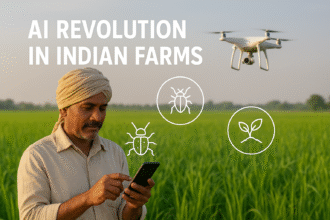
Drone technology expands rapidly in precision agriculture applications. Agricultural drones provide high-resolution crop monitoring. Spray drones enable targeted pesticide applications. Seeding drones support precision planting in difficult terrain.
Robotic manufacturers are establishing Indian operations. John Deere’s autonomous tractors are being tested in Punjab. Mahindra develops autonomous spraying systems. Local startups create affordable robotic solutions for specific applications.
Cost considerations influence robotics adoption patterns. High-value crops justify robotics investments more easily. Custom service models make robotics accessible to smaller farms. Leasing options reduce upfront investment requirements.
Water Management Precision
Precision irrigation represents a critical application in water-scarce India. Soil moisture sensors guide irrigation timing and quantity. Weather-based irrigation scheduling optimizes water use efficiency. Variable-rate irrigation adjusts application rates across fields.
Drip irrigation systems integrate with precision agriculture platforms. Fertigation systems provide precise nutrient delivery. Automated valve control responds to sensor inputs. Mobile applications enable remote monitoring and control.
Water savings are substantial across different irrigation methods. Precision sprinkler systems reduce water usage by 25-30%. Optimized drip irrigation saves 35-40% compared to traditional methods. Smart irrigation scheduling prevents over-watering and under-watering.
Irrigation equipment manufacturers offer integrated solutions. Netafim provides precision drip systems with automation. Rain Bird offers smart sprinkler control systems. Jain Irrigation develops affordable precision solutions for Indian farmers.
Economic Analysis and ROI
Return on investment analysis drives precision agriculture adoption decisions. Initial investment costs vary significantly by technology type and farm size. Simple GPS guidance systems require ₹2-5 lakhs investment. Comprehensive precision agriculture systems cost ₹15-25 lakhs for large farms.
Payback periods range from 2-5 years depending on technology and crop type. Variable-rate fertilizer application typically pays back within 2-3 years. GPS guidance systems recover costs within 3-4 years. Comprehensive monitoring systems require 4-5 years for complete payback.
Annual savings accumulate through multiple sources. Input cost reductions average ₹8,000-15,000 per hectare. Yield improvements add ₹10,000-20,000 per hectare value. Labor savings contribute ₹3,000-8,000 per hectare. Quality improvements enable premium pricing.
Financing options support precision agriculture adoption. Equipment manufacturers offer financing packages. Banks provide technology loans with favorable terms. Government subsidies reduce upfront costs by 40-60%.
Regional Adoption Patterns
Adoption patterns vary significantly across Indian states based on crop types, farm sizes, and government support. Northern states lead in cereal crop precision agriculture. Western states focus on cash crop applications. Southern states emphasize horticulture precision management.
Punjab demonstrates the highest overall adoption rates. Large wheat and rice farms utilize comprehensive precision agriculture systems. Government support programs subsidize technology adoption. Demonstration plots showcase benefits to neighboring farmers.
Maharashtra shows strong adoption in sugarcane and horticulture. Drip irrigation integration drives precision agriculture interest. Grape and pomegranate cultivation utilizes advanced monitoring systems. Cotton farmers adopt variable-rate technology for input optimization.
Karnataka’s precision agriculture focuses on horticulture crops. Coffee plantations use precision irrigation and fertilization. Vegetable cultivation benefits from greenhouse automation. Floriculture operations utilize comprehensive environmental control systems.
Farmer Education and Training
Education programs are crucial for successful precision agriculture adoption. Government extension services provide basic training on precision agriculture concepts. Private companies offer equipment-specific training programs. Agricultural universities integrate precision agriculture into curricula.
Training effectiveness improves through hands-on demonstration. On-farm demonstrations show practical applications and benefits. Farmer field schools provide sustained learning opportunities. Peer-to-peer learning accelerates knowledge transfer.
Digital platforms expand training accessibility. Mobile applications provide tutorial videos and troubleshooting guides. Online courses cover theoretical concepts and practical applications. Virtual reality training simulates equipment operation.
Certification programs validate precision agriculture expertise. Private companies certify equipment operators. Agricultural organizations recognize precision agriculture specialists. Professional development programs advance technical skills.
Integration with Government Schemes
Government schemes increasingly incorporate precision agriculture components. PM-KISAN provides financial support for technology adoption. Pradhan Mantri Fasal Bima Yojana integrates precision agriculture data. Soil Health Card scheme connects with precision soil management.
State government programs target specific precision agriculture applications. Punjab’s mechanization scheme includes GPS-guided equipment. Maharashtra’s irrigation programs support precision water management. Karnataka’s horticulture development includes precision fertigation systems.
Policy support creates enabling environments for precision agriculture. Equipment import duties are reduced for precision agriculture technology. Research funding supports development of indigenous solutions. Training programs build human capacity for technology adoption.
Challenges and Solutions
Technical challenges include equipment complexity, maintenance requirements, and data management needs. Solutions involve simplified user interfaces, local service networks, and cloud-based data platforms.
Economic challenges include high upfront costs, uncertain returns, and financing limitations. Solutions include leasing options, cooperative purchasing models, and government subsidy programs.
Infrastructure challenges encompass internet connectivity, power supply, and technical support availability. Solutions involve rural connectivity improvements, renewable energy systems, and distributed service networks.
Future Technology Trends
Emerging technologies promise enhanced precision agriculture capabilities. Artificial intelligence improves decision-making accuracy. Internet of Things (IoT) enables comprehensive monitoring systems. Blockchain technology ensures data integrity and traceability.
5G connectivity will revolutionize real-time data processing and autonomous equipment operation. Edge computing reduces dependency on internet connectivity. Augmented reality provides immersive training and troubleshooting experiences.
Integration trends focus on comprehensive farm management platforms. Single interfaces manage multiple precision agriculture technologies. Data integration provides holistic farm performance insights. Automated systems reduce human intervention requirements.
Global Comparisons and Competitiveness
Indian precision agriculture adoption compares favorably with global trends. Adoption rates in progressive states match developed country levels. Cost-effective solutions create competitive advantages. Large-scale implementation demonstrates global leadership potential.
Technology development capabilities are strengthening rapidly. Indigenous solutions reduce dependency on imports. Innovation hubs attract international collaboration. Startup ecosystem creates disruptive technologies.
Export opportunities emerge from successful domestic implementations. Equipment manufacturers expand internationally. Software solutions serve global markets. Consulting services support international precision agriculture development.
The embrace of data-driven agriculture by Indian farmers represents a fundamental shift toward scientific, sustainable, and profitable farming. Precision agriculture technologies are proving their value across diverse crops, regions, and farm sizes, creating a foundation for India’s agricultural modernization and global competitiveness.