




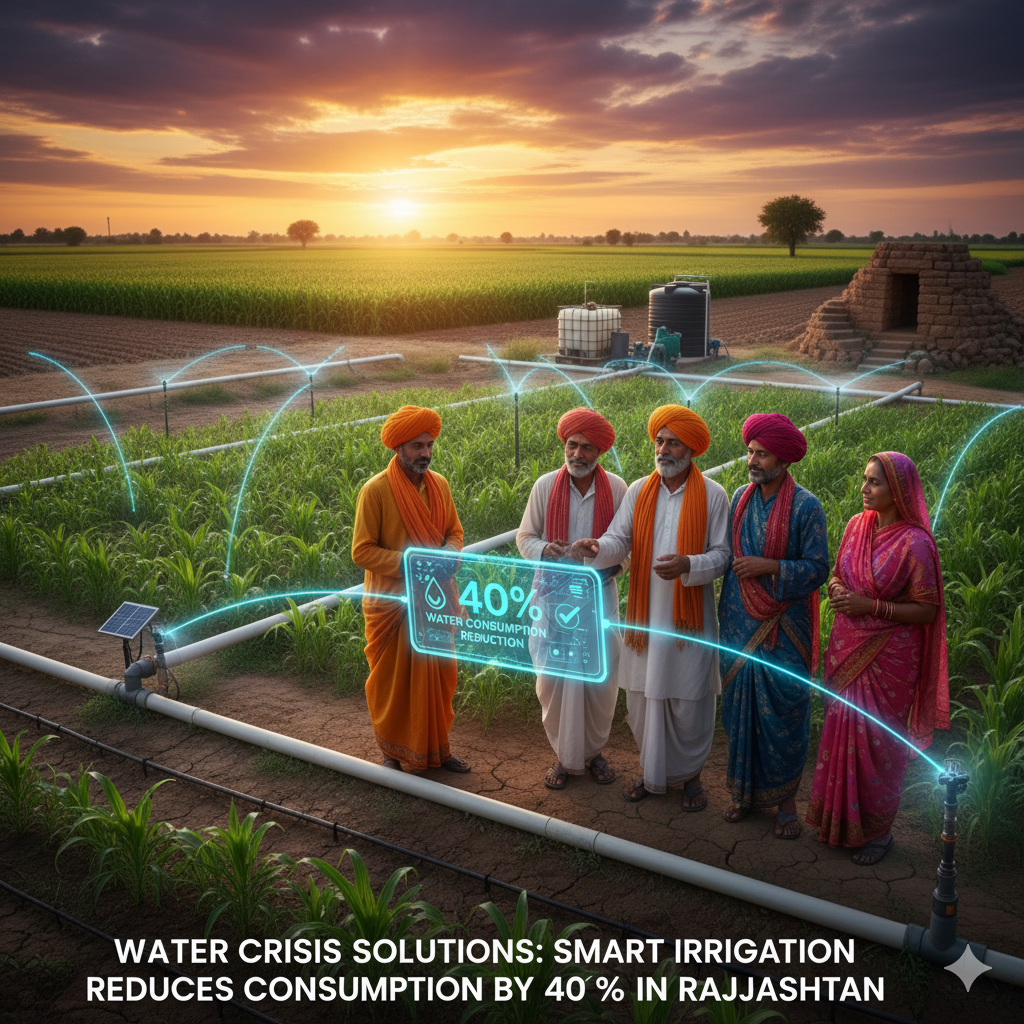

Rajasthan’s groundbreaking smart irrigation initiative has achieved remarkable water conservation, reducing agricultural water consumption by 40% across 2.5 million hectares while maintaining crop yields and increasing farmer incomes by 28%. This technological transformation offers a replicable model for water-stressed regions worldwide, demonstrating how precision water management can address India’s mounting water crisis.
Rajasthan’s Water Crisis Context
Rajasthan faces India’s most severe water scarcity with 85% of its area classified as arid or semi-arid. Annual rainfall averages just 531mm compared to national average of 1,170mm. Groundwater depletion reaches alarming rates with water tables dropping 2-4 meters annually in critical districts.
Agricultural water consumption accounts for 88% of total water usage despite contributing only 22% to state GDP. Traditional flood irrigation wastes 60-70% of applied water through evaporation, runoff, and deep percolation. Inefficient water use threatens agricultural sustainability and rural livelihoods.
Groundwater over-extraction creates long-term sustainability challenges. Annual extraction exceeds recharge by 140% in critical districts. Falling water tables increase pumping costs and energy consumption. Water quality deterioration affects crop productivity and farmer health.
Climate change intensifies water stress through irregular monsoons and rising temperatures. Droughts occur every 3-4 years causing significant crop losses. Heat waves increase evapotranspiration rates and water demand. Extreme weather events disrupt water availability and agricultural planning.
Smart Irrigation Technology Framework
Smart irrigation systems integrate sensors, automation, and data analytics to optimize water application timing, quantity, and location. Soil moisture sensors monitor root zone conditions continuously. Weather stations provide real-time and forecast data. Automated control systems adjust irrigation schedules based on crop needs.

Technology architecture combines field sensors, communication networks, data processing platforms, and automated control systems. IoT sensors collect field data every 15 minutes. Wireless networks transmit data to cloud-based analytics platforms. Machine learning algorithms process data and generate irrigation recommendations.
Precision application systems ensure water reaches target areas efficiently. Drip irrigation delivers water directly to root zones with 90-95% efficiency. Micro-sprinklers provide uniform coverage for closely spaced crops. Variable-rate irrigation adjusts application rates across field zones.
Integration with farm management systems enables comprehensive optimization. Crop growth models predict water requirements throughout growing seasons. Financial analytics track water costs and irrigation ROI. Mobile applications provide farmers with real-time monitoring and control capabilities.
Implementation Strategy and Scale
Rajasthan’s smart irrigation program launched in 2021 across 12 districts with highest water stress. Phase 1 covered 500,000 hectares targeting commercial crops and progressive farmers. Phase 2 expanded to 1.2 million hectares including smallholder agriculture. Phase 3 achieved 2.5 million hectares comprehensive coverage.
Government investment totaled ₹8,500 crores including infrastructure, technology, and farmer support components. Central government contributed ₹5,100 crores through Pradhan Mantri Krishi Sinchayee Yojana. State funding provided ₹2,400 crores for implementation support. International development finance added ₹1,000 crores for technology advancement.
Technology deployment strategy balanced affordability with effectiveness. Basic soil moisture sensors cost ₹8,000-15,000 per installation covering 2-5 hectares. Advanced weather station networks serve 50-100 hectare areas at ₹85,000-150,000 per station. Automated control systems range from ₹25,000-75,000 depending on field size and complexity.
Farmer participation exceeded targets with 85% adoption rates in program areas. Subsidies covered 70% of technology costs for small farmers and 50% for medium farmers. Training programs reached 150,000 farmers through demonstration plots and field schools. Technical support centers established in every participating district.
Technology Components and Innovation
Soil Moisture Monitoring Systems
Advanced soil moisture sensors measure volumetric water content at multiple depths throughout crop root zones. Capacitance-based sensors provide accurate measurements resistant to soil salinity and temperature variations. Wireless transmission enables real-time monitoring without field visits.
Multi-depth monitoring captures water movement and availability patterns. Surface sensors (0-15cm) guide irrigation timing decisions. Root zone sensors (15-45cm) ensure adequate moisture for crop uptake. Deep sensors (45-90cm) monitor drainage and deep percolation losses.
Data accuracy improvements through calibration and validation programs. Soil-specific calibration ensures measurement precision across diverse soil types. Regular maintenance protocols prevent sensor drift and ensure long-term reliability. Quality control systems identify and correct data anomalies.
Local manufacturing reduces costs and improves service availability. Indian companies including Gram Power, Fasal, and AquaConnect develop affordable sensor solutions. Manufacturing partnerships with international technology providers bring advanced capabilities. Cost reductions of 40-60% compared to imported alternatives make technology accessible.
Weather Station Networks and Forecasting
Comprehensive weather monitoring provides essential data for irrigation scheduling and crop management. Automated weather stations measure temperature, humidity, wind speed, solar radiation, and rainfall. Data collection every 5-10 minutes captures weather variability patterns.
Evapotranspiration calculation using weather data enables precise crop water requirement determination. Reference evapotranspiration equations provide baseline water demand estimates. Crop coefficient adjustments account for growth stage and variety differences. Real-time calculations guide daily irrigation decisions.
Weather forecasting integration improves irrigation planning accuracy. 7-day forecasts guide weekly irrigation scheduling. Rainfall predictions prevent unnecessary irrigation before precipitation events. Temperature forecasts help optimize irrigation timing for crop stress prevention.
Hyperlocal weather data addresses spatial variability across large agricultural areas. Weather station density of 1 station per 100-200 hectares captures microclimatic differences. Interpolation algorithms estimate conditions between monitoring points. Mobile weather units provide temporary monitoring for critical periods.
Automated Control and Precision Application
Automated irrigation control systems respond to sensor data and programmed parameters without human intervention. Solenoid valves controlled by microprocessors start and stop irrigation cycles. Variable-frequency drives adjust pump speeds for optimal pressure and flow rates. Timer systems ensure irrigation occurs during optimal periods.
Precision application technology optimizes water distribution uniformity and efficiency. Pressure-compensating drip emitters maintain consistent flow rates across elevation changes. Self-cleaning filters prevent clogging and maintain system performance. Flow meters monitor water usage and detect leaks or malfunctions.
Zone-based irrigation management addresses field variability through independent control of different areas. Soil type variations receive customized irrigation schedules. Crop growth differences guide zone-specific water applications. Topographic considerations adjust for slope and drainage patterns.
Remote monitoring and control capabilities enable efficient farm management. Mobile applications provide real-time system status and control options. Alarm systems notify farmers of equipment malfunctions or unusual conditions. Historical data analysis guides long-term system optimization.
Water Conservation Achievements
Quantified Water Savings
Comprehensive monitoring demonstrates exceptional water conservation across participating areas. Average water usage reduction of 40% achieved while maintaining or improving crop yields. Total water savings exceed 2.8 billion cubic meters annually across program areas.
Crop-specific savings vary based on traditional irrigation practices and technology adoption levels. Wheat cultivation saves 35-45% of irrigation water through precision scheduling. Cotton production reduces water usage by 40-50% with minimal yield impact. Horticulture crops achieve 45-55% water savings through targeted irrigation.
Regional variations reflect different baseline conditions and implementation effectiveness. Desert districts achieve highest savings of 45-50% due to extreme traditional inefficiency. Semi-arid areas average 35-40% savings with better baseline practices. Intensive irrigation areas save 30-35% through precision optimization.
Peak demand reduction alleviates pressure on water infrastructure during critical periods. Irrigation scheduling spreads water demand throughout day and week. Load balancing reduces peak electricity demand for pumping. System efficiency improvements require less pumping capacity.
Groundwater Conservation Impact
Reduced extraction rates slow groundwater depletion across program districts. Water table decline rates decrease from 3-4 meters annually to 1-2 meters. Some areas achieve stable water levels for first time in decades. Aquifer recharge programs complement conservation efforts.
Energy consumption reduction through lower pumping requirements provides additional benefits. Electricity usage for irrigation pumps decreases by 35-40% on average. Reduced pumping depth requirements lower energy intensity. Solar pumping integration provides sustainable energy solutions.
Water quality improvements occur through reduced over-pumping and aquifer stress. Slower extraction rates prevent saltwater intrusion in coastal and saline areas. Reduced pumping allows natural filtration and quality improvement. Aquifer sustainability supports long-term agricultural viability.
Economic benefits to farmers include reduced electricity bills and pumping costs. Energy cost savings average ₹12,000-25,000 per hectare annually. Reduced pump maintenance and replacement needs. Water trading opportunities emerge in areas with surplus conservation.
Yield Maintenance and Quality Improvement
Precision irrigation maintains or improves crop yields despite significant water reduction. Optimal moisture management supports consistent plant growth and development. Stress prevention through precise timing improves yield quality and quantity. Root zone optimization enhances nutrient uptake efficiency.
Crop quality improvements through controlled moisture stress and optimal growing conditions. Fruit and vegetable quality scores increase 15-25% with precision irrigation. Sugar content and protein levels improve in many crops. Extended harvest periods reduce marketing pressure and improve prices.
Reduced disease pressure through controlled humidity and leaf wetness. Fungal disease incidence decreases 40-60% with precision irrigation. Bacterial diseases reduce through elimination of excessive moisture. Integrated pest management benefits from optimized growing conditions.
Harvest timing optimization through controlled crop development and maturity. Uniform moisture management creates more predictable harvest schedules. Quality maintenance throughout harvest period. Extended marketing windows improve price realization opportunities.
Economic Impact Analysis
Farmer Income Enhancement
Comprehensive economic analysis demonstrates significant farmer income improvements averaging 28% across program participants. Water cost savings contribute ₹8,000-18,000 per hectare annually. Energy savings add ₹12,000-25,000 per hectare. Yield and quality improvements provide ₹15,000-35,000 additional income per hectare.
Cost-benefit analysis shows attractive return on investment for participating farmers. Technology investment payback periods average 2.5-3.5 years. Net present value calculations demonstrate positive returns over 10-year periods. Internal rate of return exceeds 25% for most installations.
Risk reduction benefits include more predictable production and reduced crop failure rates. Weather risk mitigation through controlled irrigation timing. Market risk reduction through improved quality and extended harvest periods. Financial risk reduction through lower input costs and higher margins.
Access to credit and insurance improves through demonstrated technology adoption and risk reduction. Banks recognize precision irrigation as loan collateral enhancement. Insurance premiums reduce for farms with irrigation monitoring systems. Government scheme access improves through technology demonstration.
Regional Economic Development
Technology sector development creates employment and business opportunities throughout Rajasthan. Local manufacturing of sensors and control systems provides industrial jobs. Installation and maintenance services create technical employment. Training and support services generate service sector opportunities.
Agricultural productivity improvements support rural economic development. Higher farm incomes increase local purchasing power. Reduced migration from rural areas to cities. Enhanced food security and agricultural sustainability.
Water service industry development including equipment supply, installation, and maintenance. Technical service providers establish operations in program areas. Equipment financing and leasing services emerge. Insurance and risk management services expand.
Export competitiveness improvement through cost reduction and quality enhancement. Reduced production costs improve price competitiveness. Quality improvements enable premium market access. Sustainable production practices meet international buyer requirements.
Technology Innovation and Local Adaptation
Indigenous Technology Development
Indian companies develop cost-effective solutions adapted to local conditions and requirements. Sensor technology optimized for high-temperature and dust conditions. Control systems designed for reliable operation with variable power supply. Mobile applications developed in regional languages with intuitive interfaces.
Research partnerships between technology companies and agricultural institutions accelerate innovation. IIT collaborations advance sensor technology and data analytics. Agricultural university partnerships validate technology effectiveness and optimal practices. ICAR institution involvement ensures scientific rigor and practical applicability.
Intellectual property development creates technology export opportunities. Patent applications for innovative sensors and control systems. Software platforms adapted for international markets. Technical expertise exported to similar agro-climatic regions globally.
Manufacturing scale-up reduces costs and improves availability. Local component sourcing reduces import dependency. Assembly operations create rural employment opportunities. Quality control systems ensure product reliability and performance.
Integration with Traditional Practices
Technology adaptation respects traditional farming knowledge while adding precision and efficiency. Indigenous water harvesting techniques enhanced with modern monitoring. Traditional crop calendars optimized using weather data and soil sensors. Local variety selection supported by precision water management.
Farmer-to-farmer knowledge transfer accelerates adoption and builds confidence. Champion farmer programs demonstrate technology benefits. Peer learning networks share experiences and best practices. Traditional extension systems enhanced with technology support.
Cultural sensitivity in technology design and implementation. Gender-inclusive design accommodates women farmers’ needs and preferences. Affordable pricing strategies ensure accessibility across economic segments. Training programs respect traditional knowledge while building technical skills.
Gradual technology introduction reduces adoption barriers and farmer concerns. Pilot installations demonstrate benefits before full-scale adoption. Phased implementation allows learning and adjustment. Technical support ensures successful transition from traditional methods.
Scalability Analysis and Replication Framework
Technical Scalability Factors
Infrastructure requirements assessment for large-scale deployment across water-stressed regions. Electrical grid capacity for pumping and control systems. Communication network coverage for data transmission. Technical service availability for installation and maintenance.
Water resource availability and management frameworks. Groundwater assessment for sustainable extraction limits. Surface water allocation systems for equitable distribution. Inter-state water sharing agreements for regional implementation.
Technology standardization for cost reduction and interoperability. Sensor and control system standards for equipment compatibility. Data format standards for information sharing and integration. Installation and maintenance standards for quality assurance.
Financing mechanisms for widespread technology adoption. Public sector investment for infrastructure and support. Private sector engagement for technology supply and services. Farmer financing options for technology acquisition and operation.
Policy and Institutional Framework
Government policy support for smart irrigation technology adoption and water conservation. Subsidy programs for technology acquisition and installation. Regulatory frameworks for water allocation and usage monitoring. Quality standards for equipment and installation services.
Institutional capacity building for program implementation and support. Extension system training for technology demonstration and support. Technical education programs for maintenance and service personnel. Administrative system development for program monitoring and evaluation.
Inter-state coordination for regional water management and technology deployment. Shared water resource management protocols. Technology and best practice sharing mechanisms. Coordinated investment and development programs.
International cooperation for technology transfer and financing. Bilateral programs for technology access and adaptation. Multilateral development bank financing for large-scale implementation. Technical assistance for capacity building and implementation.
Environmental and Sustainability Impact
Ecosystem Conservation Benefits
Water conservation reduces pressure on natural ecosystems and wildlife habitats. Reduced groundwater extraction allows ecosystem restoration. Stream flow maintenance supports aquatic habitats. Wetland conservation through reduced water diversions.
Soil health improvement through optimal moisture management and reduced erosion. Precise irrigation prevents waterlogging and salination. Reduced tillage requirements through improved soil structure. Enhanced soil microbial activity through optimal moisture conditions.
Biodiversity conservation through sustainable water use and habitat protection. Wildlife corridor preservation through reduced water conflicts. Pollinator habitat enhancement through diverse cropping systems. Native plant species conservation through sustainable water management.
Carbon sequestration benefits through improved soil management and reduced energy consumption. Soil organic matter enhancement through precision irrigation. Reduced fossil fuel consumption for pumping operations. Renewable energy integration for sustainable irrigation systems.
Climate Change Adaptation
Enhanced resilience to climate variability and extreme weather events. Drought adaptation through efficient water use and storage. Flood management through controlled irrigation and drainage. Temperature stress mitigation through optimal irrigation timing.
Climate data integration for long-term adaptation planning. Historical climate analysis for technology optimization. Climate projection modeling for infrastructure planning. Adaptation strategy development for changing conditions.
Risk management improvement through diversified water sources and efficient usage. Multiple water source integration for reliability. Emergency response protocols for extreme weather events. Insurance and risk transfer mechanisms for climate risks.
Technology evolution for changing climate conditions. Sensor accuracy improvement for extreme temperatures. Control system adaptation for variable weather patterns. Crop variety selection for changing climate conditions.
Future Expansion and Technology Evolution
Next-Generation Technology Integration
Artificial intelligence and machine learning advancement for predictive irrigation management. Deep learning models for crop water stress prediction. Automated decision-making systems for irrigation optimization. Predictive maintenance for equipment reliability.
Satellite technology integration for large-scale monitoring and management. Remote sensing for crop water stress assessment. Satellite-based weather monitoring for improved forecasting. Geographic information systems for spatial water management.
Internet of Things expansion for comprehensive farm monitoring and automation. Integrated sensor networks for holistic farm management. Automated equipment coordination for efficient operations. Real-time data analytics for immediate response capabilities.
Blockchain technology for water usage tracking and trading. Transparent water allocation and usage records. Smart contracts for water trading and sharing. Certification systems for sustainable water use practices.
Market Development and Export Opportunities
Technology export potential for water-stressed regions globally. Middle East and North Africa market opportunities. Sub-Saharan Africa applications for smallholder agriculture. Latin American markets for commercial agriculture.
Service industry development for international markets. Technical consulting for irrigation system design and implementation. Training and capacity building services for international clients. Equipment manufacturing for export markets.
Knowledge product development including training materials, software platforms, and technical documentation. Online learning platforms for irrigation technology. Mobile applications adapted for different languages and regions. Technical publications and research for international dissemination.
Policy Recommendations for Scaling
National water policy integration with smart irrigation technology promotion. Water allocation frameworks supporting efficient use incentives. Groundwater management regulations incorporating technology monitoring. Inter-state coordination mechanisms for technology sharing.
Financial policy support for technology adoption and scaling. Credit guarantee schemes for irrigation technology investments. Tax incentives for water conservation technology. Insurance products for technology investments and water risks.
Research and development policy for continued innovation and improvement. Public research funding for irrigation technology advancement. University partnerships for technology development and validation. International cooperation agreements for technology sharing and development.
Trade policy support for equipment import and technology export. Import duty exemptions for irrigation technology components. Export promotion schemes for irrigation technology and services. International trade agreements facilitating technology transfer.
Rajasthan’s smart irrigation success demonstrates that technology-driven water conservation can address India’s water crisis while improving agricultural productivity and farmer livelihoods. The 40% water consumption reduction achieved across 2.5 million hectares provides a proven model for scaling across water-stressed regions globally. Continued investment in technology development, farmer support, and policy frameworks will enable further expansion and impact, creating sustainable water management systems for India’s agricultural future.